Listen: Relationships: The Infrastructure of Possibility read by Kelly Tenkely
There’s a common refrain every time we discover a school that seems to be doing the impossible, inevitably the question is asked, “how do we replicate it?”
It’s an understandable question. It’s also the wrong one.
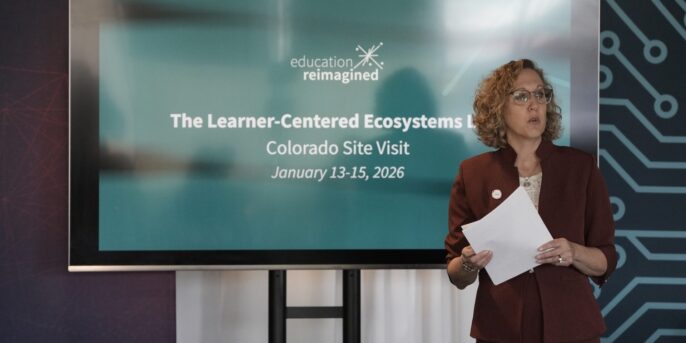
Over the last year, we’ve traveled across Colorado and the country with Education Reimagined as members of the second cohort of their Learner-Centered Ecosystem Lab. We’ve had the privilege of visiting extraordinary learning communities. Schools where young people move fluidly between classroom and community. Where educators act more like guides and ethnographers than lecturers. Where learning feels alive with meaning because it’s inseparable from life itself.
You can’t help but leave these communities inspired. And so often, people return to a reality that is out of step with what they’ve just experienced. Their district doesn’t allow it. The funding model doesn’t fit. The accountability system measures something different. The barriers begin to stack up. These barriers are rarely about the quality of learning, they’re about everything surrounding it.
That relational infrastructure—the noticing, the trust, the willingness to follow a learner’s lead—is what made everything possible.
Kelly tenkely
In our final cohort gathering, I sat in a discussion about policy, interested to explore how policy could help with these barriers. My assumption was that so many of these barriers were policy problems. Now I wonder if they are bigger than policy. I wonder if they are primarily infrastructure problems.
None of the innovation we’ve witnessed happened because someone perfectly anticipated the future and crafted the right policies. It happened because a network of educators, learners, families, and community partners built relationships close enough to notice what mattered, and trusted those relationships enough to let them lead somewhere new. That relational infrastructure—the noticing, the trust, the willingness to follow a learner’s lead—is what made everything possible.
At Anastasis Academy and La Luz, we saw what that looks like in practice.
What a Relationship Makes Possible
At Anastasis, learning didn’t begin with a boxed curriculum. In fact, there was no prepackaged curriculum at all. Our curriculum was living. It emerged from the young people in front of us, responding to their questions, interests, developmental needs, and growing understanding of the world.
None of this was possible without first knowing each learner well. That’s why each year began intentionally with connection. Using the Learning Genome connection cards, educators explored who each child was, how they understood themselves as a learner, and the ways they were uniquely intelligent. That understanding was the foundation from which we co-designed learning, and it’s what positioned one educator to recognize a moment most classrooms would have passed right by.
One year, a group of 10 to 12-year-old learners was reading Sharon M. Draper’s Out of My Mind. During a discussion about Melody, the book’s protagonist, one learner observed that she didn’t think she had ever known someone with a disability. Her classmates all echoed her realization. As their teacher listened to their questions and observations, she recognized an opportunity.
Each Anastasis class partnered with a local nonprofit organization for the year. This class formed a relationship with Stepping Stone Support Center, an organization serving adults with developmental disabilities. Through repeated visits, learners built friendships, expanded their understanding of disability, and began recognizing the ways our world can privilege some bodies and minds over others.
During one visit, learners worked alongside their new friends to pack food boxes for Thanksgiving. One learner overheard a program director mentioned that they expected to be 25 boxes short that year.
“What does that mean?” she asked.
Sometimes, the director explained, there aren’t enough donations to meet the need.
When the learner shared this with her class during their reflection, her classmates were collectively outraged at the thought that 25 families might go without a Thanksgiving meal. They began calculating the cost of each box and brainstorming ways to close the gap.
The learner who first identified the problem was frustrated that so many fundraising ideas required spending money before they could earn it. She wanted every dollar raised to support the families. She lived on a ranch and had horses, her passion outside of school, and wondered whether she could offer horse rides and create a small petting zoo at school. This idea became the living curriculum.
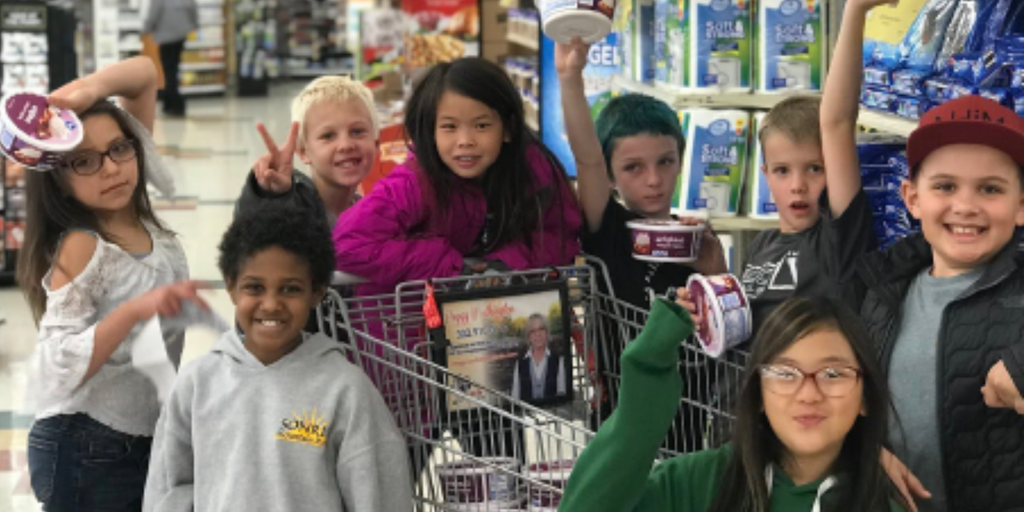
She had to persuade the building owner, present a clear argument, work with the school office to address liability and create waivers, convince her parents to bring the horses, market the event to school families and local neighbors, and teach us all about proper brushing, feeding, and riding techniques.
She single-handedly raised enough money to fund all 25 missing boxes. Her classmates raised enough to add a pie to every box, both those they had packed previously and the 25 additional boxes. When the learners visited the grocery store to purchase the food, they asked to meet with the manager and explained what they were doing. They hoped he could help them find the best prices, he did one better and discounted the entire purchase.
Mathematics, literacy, civil engagement, empathy, advocacy, and project management weren’t separated into subjects but instead became the tools the learners used to do something that mattered.
Kelly Tenkely
We see this same pattern of community engagement at La Luz, where learners spend six weeks at a time embedded with community organizations and where the organization’s place of work becomes the classroom. Six weeks at the zoo offers an immersive exploration of the complexities of conservation. Six weeks at the History of Colorado allows learners to work alongside museum professionals as they develop a multifaceted understanding of the Dust Bowl.
None of this happened because a curriculum called for it. It happened because a teacher trusted where a learner’s question led. Because a grocery store manager said yes, not to a form, but to a group of young people who showed up and explained their idea. Museums and zoos opened their doors to learners as partners rather than visitors, and the line between school and community began to dissolve. Mathematics, literacy, civil engagement, empathy, advocacy, and project management weren’t separated into subjects but instead became the tools the learners used to do something that mattered.
Policy Follows Relationships
This is why our thinking is evolving. We no longer believe innovation needs policy to exist. Policy matters and can certainly inhibit innovation, but policy rarely leads. It generally follows when enough people have experienced a different possibility and when communities begin expecting something new.
At CultivatED Colorado, our work isn’t about building one perfect model of school. We already have remarkable innovators, and like to count ourselves among them. What we’ve come to recognize is that relational infrastructure is needed for those innovators to flourish.
What might that infrastructure be?
Infrastructure isn’t glamorous and we usually don’t notice it until it’s missing. The same is true of relationships. We rarely name them as infrastructure, yet nothing else, not the curriculum, not the fundraiser, not the partnership with the zoo or the food bank, would have been possible without them. If we want Colorado to be the best place to be a learner, this is the infrastructure worth building toward, investing in, and protecting.
The future of education won’t emerge from a single school, but from an ecosystem of relationships that makes extraordinary learning no longer seem extraordinary.
Follow more of Kelly’s work at KT’s Place, her living archive of projects and ideas.