How do ideas spread? Through necessity, connection, and common values.
The story of how the Big Picture Learning design took root in Australia shows this in action. Over time, implementation in a new context led to innovation on how to assess and communicate student learning in the creation of a new kind of high school credential: the International Big Picture Learning Credential (IBPLC).
Thirty years since the opening of the Met High School, the momentum continues to build. Big Picture’s evolution in Australia offers perspective and inspiration to increase our efforts to provide new forms of learning to high school students and new measures of their readiness.
As Portraits of a Learner gain momentum as a tool for defining a broader set of learning outcomes students need to thrive, schools need new ways to assess new learning goals. The IBPLC offers a well-developed way to anchor a local assessment system and provide a next-generation credential of value at the close of high school.
Grounding in the Student Experience
Before digging into the details of the learning design and the IBPLC, let’s start with the experiences of students.
A 2021 graduate of a Big Picture Learning Australia (BPLA) school recently completed her Bachelor of Nursing and is now working in an emergency department. She shared that her experience in grades 7 and 8 in a traditional school was hard for her, especially as a person with autism. She reflected, “Big Picture opened and saved my life. Despite what I deal with on a day-to-day basis, I was able to achieve my goals, which I never thought would be possible. Big Picture is a great way to get what we need.”
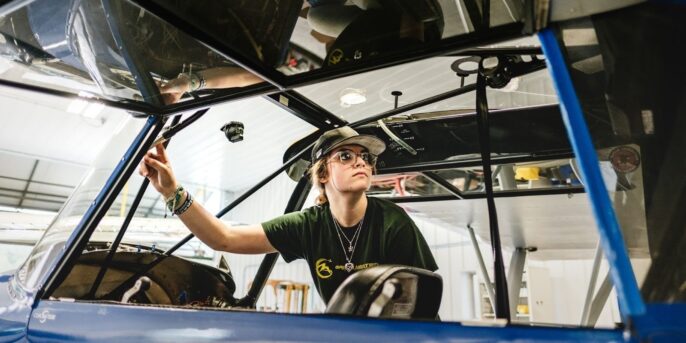
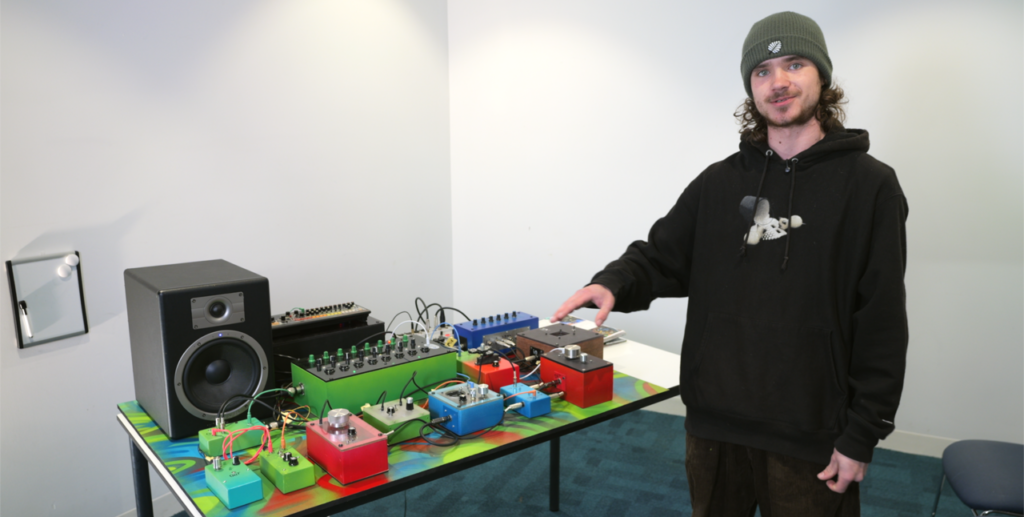
Throughout BPLA’s 2025 conference in Sydney, students swapped stories of what they were studying—from Alice’s interest in zoology with a focus on reptile care and her internship at Sydney’s Taronga Zoo to Michael’s work on cybersecurity strategies using large language models to identify vulnerabilities. While students started from different experiences in traditional schools, they had all found engagement and belonging at their Big Picture school.
The Design and Its Origins in Australia
Big Picture Learning Australia works closely with Big Picture Learning in the U.S. and uses the same design principles. The design in practice—an example of Ted Sizer’s work and the Coalition of Essential Schools in action—includes the familiar elements of advisory as a home base, personal interest projects and learning plans, learning through internships, portfolios, and public exhibitions.
“One student at a time in a community of learners” is a motto that unites and guides practitioners across settings with the goal of a school that fits the learning, rather than the learner fitting into the school.
The BPLA network now includes approximately 55 locations across Australia in major cities, regions, rural, and remote Indigenous locations, with more schools exploring how to implement the design in their context. Ten of those function as whole school programs, with all students learning through the Big Picture Learning design. The majority follow an academy model, where within a larger school, several Big Picture Learning advisories offer an option for the Big Picture learning pathway.
The Problem: Personalized Pathways Presented a Barrier to Higher Education
In 2016, three students from Hunter Sports Big Picture Academy wanted to attend university after grade 12. However, the Big Picture design did not align with the traditional way students gain entrance to higher education, through the Australian Tertiary Admission Rank (ATAR). The ATAR is a single ranking out of 100 based on each state’s Senior Secondary Certificate, which requires year 11 and 12 students to choose six discipline-based courses then sit for standardized exams. Society and educators increasingly question that this number can represent all of a young person’s skills, knowledge, and qualities, and this was a fundamental mismatch for the Big Picture design.
In 2017, the University of Newcastle, led by Pro Vice Chancellor Professor John Fischetti agreed to set up a pilot project that involved submitting the detailed portfolios of the three students from Hunters Sports to the university’s admissions team. They gained entry to study Business/Law, Physiotherapy, and Biomedicine, respectively. Their offers were based on interviews and their portfolios which contained student work artifacts (including a Senior Thesis, Autobiography, Out-Learning Summary, and Post-School Plan) to serve as evidence of their abilities and readiness. BPLA concluded that this personalized approach needed to be scaled up so as to be accessible to more students.
These tools document and communicate student learning based on well-defined, verifiable, and transparent competencies that capture the knowledge, skills, and dispositions needed for success today and in the future.
Laurie Gagnon
The Innovation: International Big Picture Learning Credential (IBPLC)
From this first exchange emerged the idea of creating a formalized and widely accepted way to measure what happens in Big Picture schools and validate it across school settings. What would become the International Big Picture Learning Credential (IBPLC) in the few years that followed is now a part of all BPLA network schools.
The task of creating an alternative to a century-old exam-based assessment system for admission to higher education required more than good intentions—it demanded rigorous design.
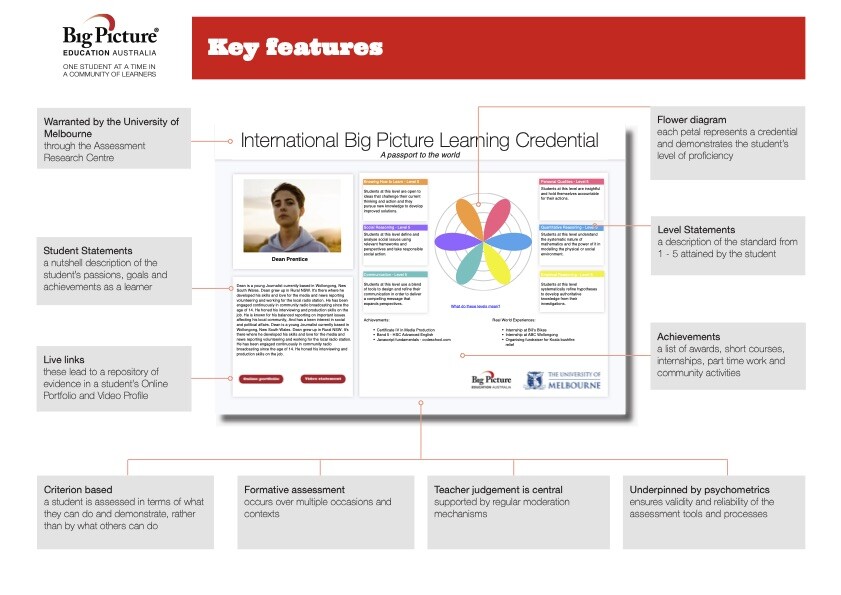
BPLA partnered with the Assessment Research Centre at the University of Melbourne (now Melbourne Metrics), led by Professor Sandra Milligan, to design an assessment system that could bridge two worlds: the personalized, interest-driven learning of Big Picture schools and the standardized expectations of universities and employers. Students in Big Picture Learning schools had evidence to show what they can do and what they know in their portfolios. The IBPLC formalized the representation of the evidence and value contained in their portfolios.
What makes the IBPLC different? Instead of asking young people to follow a single, standardized path and then explore their interests only after the assessment is done, the IBPLC starts from a different place. Each learner’s pathway can be shaped around what they’re curious about and what motivates them, while still using shared measures to understand progress and growth.
The system is built around six Learning Goals (complex competencies): knowing how to learn, empirical reasoning, quantitative reasoning, social reasoning, communication, and personal qualities. For each competency, the team developed an assessment frame with 7–10 performance indicators with qualitatively distinct descriptions across five levels. Students curate the best evidence of their learning for moderation rounds—usually once in grade 11 and twice in grade 12. The student’s advisor leads an assessment of their evidence against the assessment frames, harnessing the professional judgement of teachers who know their students deeply. The data points then get psychometrically analyzed and warranted by Melbourne Metrics at the University of Melbourne to produce a “rose” with six petals representing the level of competency the student has demonstrated on each assessment frame.
The warrant functions to build confidence in the IBPLC to guarantee that it is a fair and trustworthy credential. The goal of the process is that students recognize the value, employers and institutes of higher education accept and trust what it means, and that the information in the credential is useful because it measures a wider range of skills, knowledge, experiences, and qualities than traditional assessments.
Since 2020, more than 1,044 Big Picture students have obtained this innovative credential. Each year, approximately 30% of all IBPLC graduates choose a university pathway and achieve entry to a higher education institution. Currently, 18 of the 42 Australian Universities accept the credential. Many of these students are also the first in their family to attend university, making the IBPLC an important equity strategy that helps make higher education more accessible for all kinds of learners.
The IBPLC in Action Beyond Australia
In the past several years, the IBPLC has been earned by around 55 students in the U.S., Barbados, and Kenya. Around 60 students are expected to earn the IBPLC this spring. At Lafayette Big Picture School in New York, the past two classes graduated with the IBPLC. Kenya Big Picture Learning has leveraged the IBPLC to develop a six-month post-secondary transition program. A pilot within career and technical education at the Port of Los Angeles High School is using the credential to offer new ways for students to explore career pathways.
Making the shift to a competency-based credential such as the IBPLC is not something that happens overnight. While learner-centered educators embrace personalized pathways, translating that work into a credential requires developing shared language around competency levels, learning to calibrate evidence across diverse projects, and building systems for reliable assessment that universities and employers will trust. Establishing these practices takes intentional professional learning and collaboration over time. The good news: we have examples of schools and systems successfully making this transition. Learning from the IBPLC can support change efforts.
Looking Forward
Local assessment systems can generate the evidence to populate learner records and competency-based transcripts. These tools document and communicate student learning based on well-defined, verifiable, and transparent competencies that capture the knowledge, skills, and dispositions needed for success today and in the future.
The IBPLC in the BPLA network, and in the U.S., Kenya, and Barbados, offers an example to explore what it could look like to offer a new kind of credential at the end of high school. Clear learning outcomes and a reliable and valid way to assess those outcomes allow for flexibility in the learning design. Multiple ways for young people to learn and demonstrate their learning goals mean learners can discover their interests and the ways they excel.
There are many examples of schools doing things differently and creating new forms of learner-centered education—in the Big Picture Learning network and beyond. Just a few examples include members of Education Reimagined’s Learner-Centered Ecosystems Lab, the Canopy Schools database, competency-based education case studies, and the newly launched Future of High School network. What would it take for non-conventional credentials like the IBPLC or Mastery Transcript to become a common demonstration of learning for employers and universities across the U.S.?