Career-connected learning is having a moment.
Across the country, school systems, employers, and policymakers are racing to expand opportunities that connect students to real work and real professionals. The momentum is encouraging. For those of us who have been working in this space, it feels like the wind is finally at our backs.
But moments of rapid momentum also deserve reflection.
When demand for an idea accelerates, the marketplace responds quickly. New providers emerge. Frameworks multiply. Implementation checklists appear. Before long, the conversation can drift toward the mechanics of delivery—how many internships, how many partnerships, how many experiences.
And quietly, almost unintentionally, we risk losing sight of the deeper question:
Why are we doing this work in the first place?
Career-connected learning has enormous promise. But its real power doesn’t come from connecting students to jobs. It comes from helping young people discover who they are.
Why vs. What
As a student of economics (BA in 1999!), I know that when demand spikes, supply inevitably follows. New providers enter the market, new brands emerge, and the jockeying begins. Who can deliver the fastest solution? Who can check the boxes to prove that career-connected learning output is happening?
Too often, the conversation shifts to the mechanics—the what—while we quietly drift away from the why, losing sight of the purpose for the work.
When I joined Blue Valley School District as the Executive Director of Blue Valley CAPS in 2014, the national landscape looked very different. Career academies existed, and vocational education had long been part of the system, but the phrase “career-connected learning” had not yet entered the mainstream of education dialogue.
Around that time, a group of forward-thinking leaders began convening through the Convergence Center for Policy Resolution to wrestle with a deep, yet quite simple question:
How should we design education for learners?
That collaboration helped give rise to Education Reimagined and a framework for learner-centered education.
Learner-centered education is not simply another strategy.
It is the why.
Career-connected learning should never become another compliance exercise. Its promise lies in helping young people discover who they are and where they can contribute.
Corey Mohn
The Proof and Power of Self-Discovery
At CAPS Network, that “why” is expressed through our commitment to self-discovery.
We believe every young person, regardless of zip code, deserves an intentional journey to uncover their strengths, their interests, and the ways they can contribute meaningfully to the world. Career-connected learning, or what CAPS Network calls profession-based learning, becomes the vehicle that allows that discovery to happen in the real world.
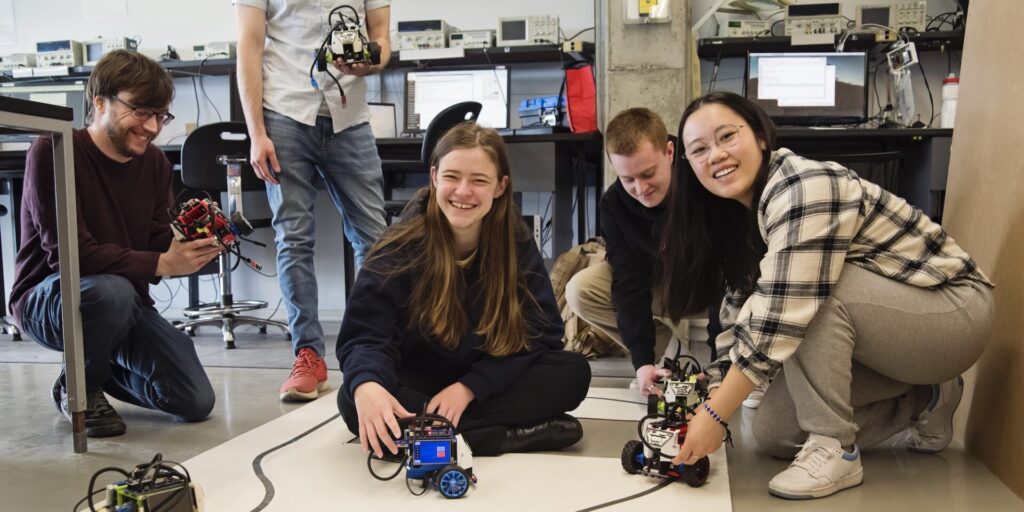
When students are placed in authentic environments and work with professionals, solving real problems, and presenting ideas that matter, they begin to see themselves differently. They start asking: “How can I make a positive impact on the world in my own, unique way?”
And the data increasingly supports this learner-centered stance.
Our recently released 2025 CAPS Network Alumni Impact Study, conducted with the University of Northern Iowa’s Strategic Marketing Services and drawing on responses from more than 1,200 alumni, provides compelling evidence. Alumni consistently describe CAPS as a turning point in how they understand themselves and their potential.
Participants report an average 4.84 out of 5 confidence score in their overall confidence after participating in CAPS experiences, with similarly strong gains in understanding their strengths and passions.
Beyond confidence, the outcomes ripple outward. CAPS alumni are entering the workforce earlier and advancing quickly—reporting average starting salaries of $48,475, roughly 50% higher than national peers, and demonstrating a three-to-four-times greater likelihood of earning six-figure incomes early in their careers. It’s clear a primary factor here is the ability to go deep in a path you love because of lots of self-discovery time prior to leaving high school.
But perhaps the most telling insight from the study is not a statistic at all.
When alumni were asked why they chose to participate in CAPS, the word that surfaced more than any other was “love.” Love for the freedom to explore real work. Love for the relationships they built with mentors and professionals. Love for the feeling of being trusted with something meaningful.
That’s not a programmatic outcome.
That’s a human one.
Learner-Centered Approaches Buoy Career-Connected Learning
Which brings us back to this moment.
The growing demand for career-connected learning is encouraging. Employers are eager for talent pipelines. Schools are searching for relevance. Policymakers are investing in new pathways. But, if we focus only on scaling the structure of career-connected learning without preserving its learner-centered foundation, we risk building something that looks impressive but lacks transformational power.
Career-connected learning should never become another compliance exercise. Its promise lies in helping young people discover who they are and where they can contribute.
As the movement grows, we would do well to anchor ourselves to that purpose. Seek out models that place learners at the center. Support experiences where students are trusted with real responsibility. Invest in environments where discovery, not just technical career preparation, is the goal.
When students are truly invited to lead their own learning journeys, confidence grows, curiosity deepens, and purpose takes root.
When that happens, career-connected learning moves far beyond a program or a policy idea.
When students are trusted to lead their own learning journeys, education stops being preparation for life, and instead becomes the place where life begins.