
“This story is about ecosystems of people who believe we are better together. This is about something bigger than what our individual organizations can do alone.”
“We believe that learning doesn’t begin and end in a classroom. It lives in neighborhoods, in maker spaces, in parks, in opportunities to explore varied career options, and in internships. It lives in relationships. And if we want to truly support our youth, we have to think in ecosystems, not just institutions.”
“Let’s offer kids space to be a kid and get to know themselves. When they know they can learn and how to learn… that’s critical for life.”
At first glance, these reflections are lovely, even inspiring, but they may not seem newsworthy, especially coming from Education Reimagined. And yet, these words are noteworthy, not because of their sentiments but because of who is saying them.
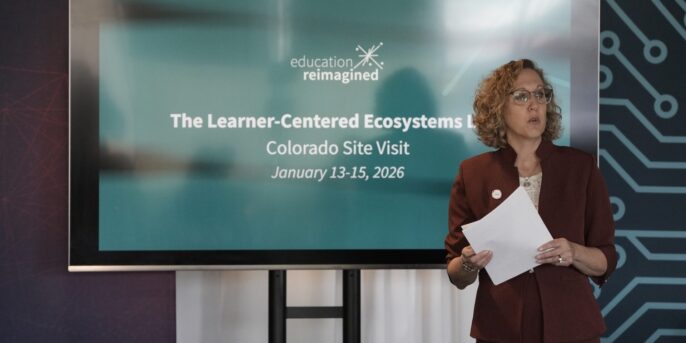
They did not come from school founders or nonprofit leaders whose explicit charge is to reimagine education. They came from a business leader, a representative from a mayor’s office, and a parent; all shared during a series of recent site visits Education Reimagined hosted in Colorado. Read them again. Do they strike a different chord?
We are hearing these sentiments with growing frequency, across geographies, sectors, and ideologies. The chorus of voices calling for something different from our education system is expanding, and strikingly, the language is converging.
Across sectors, we hear overlapping aspirations. There are calls for career-connected learning that balances hands-on, industry-integrated experience with holistic child development. There’s growing agreement that our response to the rapid evolution of AI must center relationships, discernment, and humanity, while preparing young people to be thoughtful users of new technologies. We’re seeing a shift where relevance, adaptation, and real-world contribution—which may have taken a backseat in prior conversations—are becoming core design concepts across K-12 spaces.
The entry points may differ, but these are not calls for divergent approaches to education change. They are signals pointing toward a shared orientation. In Education Reimagined’s language, they reflect a call for a learner-centered paradigm—one that sets aside long-held assumptions about where, when, and how learning must occur, and instead takes a new stance grounded in agency, belonging, and community.
This convergence is cause for celebration, full stop. It suggests a growing recognition that a more humane, community-connected, and flexible approach to education is necessary.
Yet, it also raises an urgent question: Is the field ready to meet this moment?
There is a real risk that demand for learner-centered education begins to outpace the field’s readiness to support it, particularly when it comes to the conditions to make it equitably available, spreadable, and sustainable.
The opportunity to address this demand could result in a proliferation of learning environments that wear the label of “learner-centered education” but not the practice, diluting the integrity of its implementation and raising questions about its impact. Fragmentation and inequitable access may come to characterize the field, as those with resources to invest outside the system outpace the public system’s ability to keep up. And, state and local policy may remain something to navigate or outsmart, rather than serving as an enabling, coherent context in which to realize possibility.
Creating space for coherence and coordination is key. But, this isn’t about keeping a tight leash on the learner-centered field or judging one another’s efforts. It’s about investing in what it will take to build a modern public education system ready to support each child’s growth and wellbeing.
So, let’s not ignore the supply/demand equation of learner-centered education. The potential gap between accelerating demand and insufficient field-level implementation and infrastructure is where the work must now focus.
What is needed are tangible examples of learner-centered practice operating with integrity across diverse contexts; clear and credible forms of evidence; policy conditions that enable, rather than inhibit, ecosystem-based approaches; and aligned systems, structures, and partnerships that make this work sustainable and equitable over time.
At Education Reimagined, this is the work we are committed to advancing. As we have done for the last decade, we will keep our focus on illuminating what is possible, strengthening the conditions that make it viable, and supporting the coherence the field will need if learner-centered education is to move from promise to practice with equity and long-term sustainability at the heart.
In service of closing the gap between demand and field readiness, our recent work has focused on strengthening evidence, policy pathways, and real-world proof points that the field can build from:
- Curated evidence from over 90 studies demonstrating the cognitive, social-emotional, behavioral, and long-term outcomes of learner-centered education in The Transformative Potential of Learner-Centered Education
- Outlined actionable pathways for policymakers and advocates to build education R&D engines in the State Education R&D Playbook, produced with Transcend and the Alliance for Learning Innovation
- Unpacked the systemic shifts localities are undertaking to build more interconnected, ecosystem-based learning systems in Where Learning Lives
- Examined the ripple effects of learner-centered practices for young people with learning differences, their families, learning environments, and communities in our Expanding Circles of Change research series
We’re grateful and humbled to partner every day with leaders across the nation in this work. Unified by shared vision, we find joy in charting unknown terrain, celebrating successes, reflecting on missteps, and capturing insights, lessons learned, and cautions to guide others in this journey. As the evidence builds, we know the demand will grow. Let’s be ready.