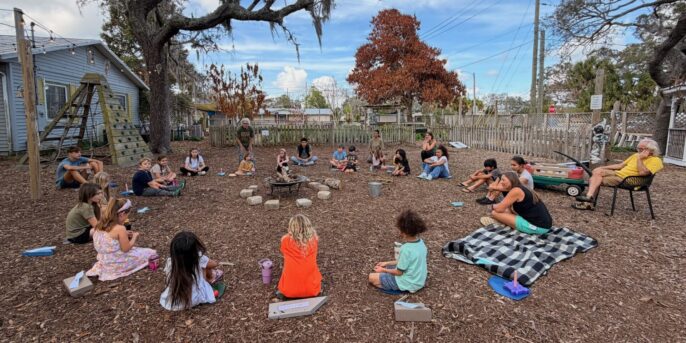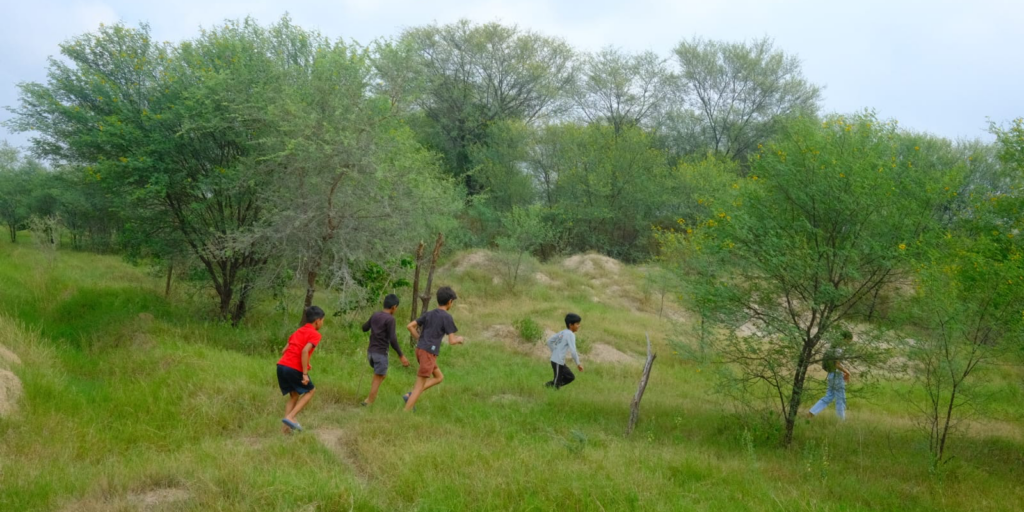
Walk through our garden at Dhun School, and you will find pits, uneven ground, half-laid brick walls, and the remnants of worlds the children have built. There are bridges, tunnels, wells, and countless mud laddoos, the round sweets made for every celebration. The children build structures, negotiate tools and space with one another, fight over something or the other, rebuild conversations, and come up with shared stories. Somewhere in this play, they start to see each other beyond the labels they arrived with.
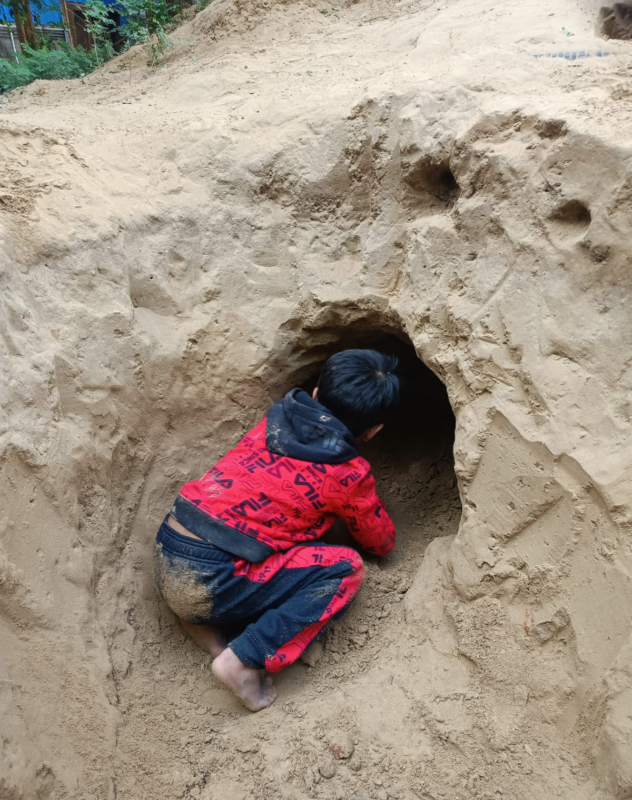
If Dhun School did not exist, these children would not meet. Dhun School sits on a bioreserve outside Jaipur, and we recently began our third year. We are a micro school of 30 children, ages 4 to 10, split roughly 40:60 between urban and rural families. In this part of India, rural children mostly attend government schools or low-fee private schools, and urban children attend higher-fee private ones, so the two rarely share a classroom. Rural families pay a small fraction of what urban families pay, so we are within reach for both.
We do not bring them together to erase their differences. Difference is not the problem. Hierarchy is: of caste, class, gender, and whose knowledge and work are seen to matter. Our work is to keep the difference and loosen the hierarchy. It is too early for us to claim that our programme works. What I can offer is what we are seeing and what we are learning.
Difference as a Resource
We start from a simple position: learning differences are universal, and variability is the rule. Our rural and urban mix does not create difference in the classroom. It makes difference visible. It also asks us to look again at what counts as learning, when children arrive with such different lives.
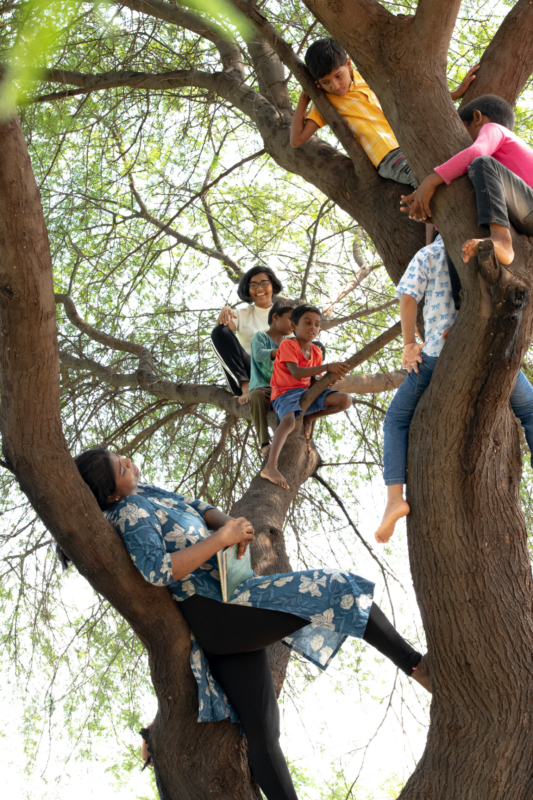
For us, this means creating diverse learning experiences where children can access information in different ways and show what they have learned. Our small size lets us teach the same concept in several subgroups at once and meet children where they are. Children here farm, climb trees, study the living world, build things, and practise arts. They also build strong foundations in literacy, English, mathematics, and the physical, natural and social sciences.
Across all of it, children lead in different moments. Some have sharp powers of observation. Others have strong language and can make a case for their ideas. Some are agile with their hands and build as an idea emerges. Others can set a goal and plan toward it over a longer stretch of time. We design so that each of these strengths has a place, and so that children learn each other’s ways of thinking and being.
Whose Knowledge Counts
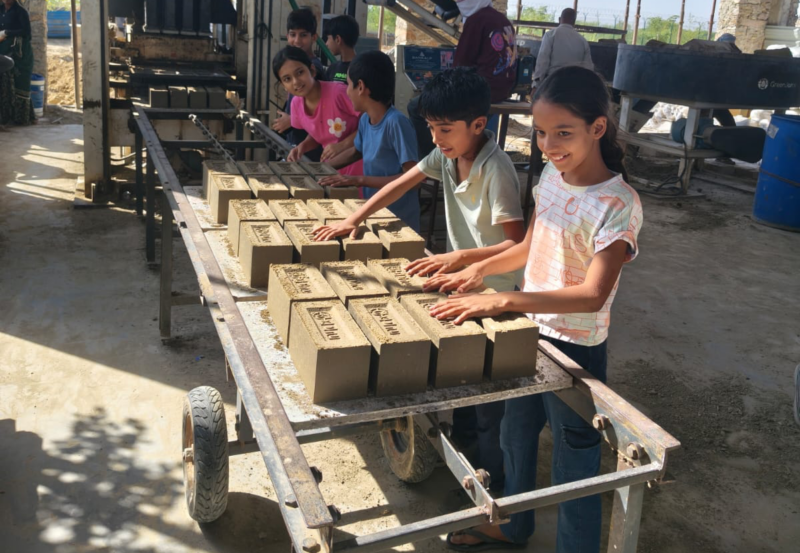
Currently, our new school building is under construction, and a group of our children is part of the process, both to advise on the experiences they want and for their own learning. They research, borrow from their own lives, and imagine. They want something that feels as grand as the Burj Khalifa and something as small as a nook to hide in. They want space for themselves and space for birds, dogs, and horses.
In this group is a child whose family owns the land the school is being built on. They have grown up inside the conversation about it, and they bring a sense of what the place could become.
In the same group is a child whose father runs a small brick kiln nearby. Brick kilns are common in our region. This child connected the days he spent at his father’s work to the mud bricks being made for our building, and he showed the group how bricks are made. The children are learning that there are many ways to make a brick. Should the bricks be fired or sun-dried? Should we use machines or human labour? As a school, we have already chosen to use mud from the site, compress it and dry it in the sun. The children do not need to settle the question for us. They are working through it at their own pace, arguing and making sense of why we chose what we did.
In most classrooms, the kiln owner’s son would not be the expert. His family’s work would be invisible, or worse, a mark of lower status. Here, he became the person everyone turned to. One child brought a vision of the place. Another brought the knowledge of how it gets built. Both counted.
When Children Set the Terms
Hierarchy also runs between adults and children, and we try to make room for children’s voices. In one heated moment, a group of children felt their norms had been broken. One child had told a facilitator what the group had discussed among themselves. The others saw this as a breach of trust and responded harshly, with words and physically.
We did not impose a consequence. We brought them together and asked them to decide. Their wisdom surprised me. Those who felt betrayed said that having their secrets shared made it feel like he was no longer part of the group, and that they could no longer trust what he said. The child they turned on said he felt disrespected when all his friends fought him. For one side, friendship meant trust. For the other, it meant respect. Neither was wrong.
When asked what should happen next, they chose to play together more. They said they fought because they do not feel connected enough, and more time together would help. This group was a mix of rural and urban children. They came in with different ideas of what friendship asks of you, and they left with a shared plan to protect it. No adult handed them that answer.
Different Hopes, One Programme
Bringing children together has proved possible. Bringing adults together is harder. Parents carry the hierarchies of caste, class and gender that their children are beginning to loosen, and they arrive with different hopes and anxieties about what school should do.
Both groups want rigour, but they mean different things by it. Urban parents want their children to take on more demanding projects, become stronger storytellers and communicators, and explore a wider range of subjects. Rural parents want their children to be good at maths and English.
Both make sense. For rural families, maths and English are what open doors to further study and secure work. Urban families can look beyond them partly because those doors are already open. Each family is planning for the future from where it stands.
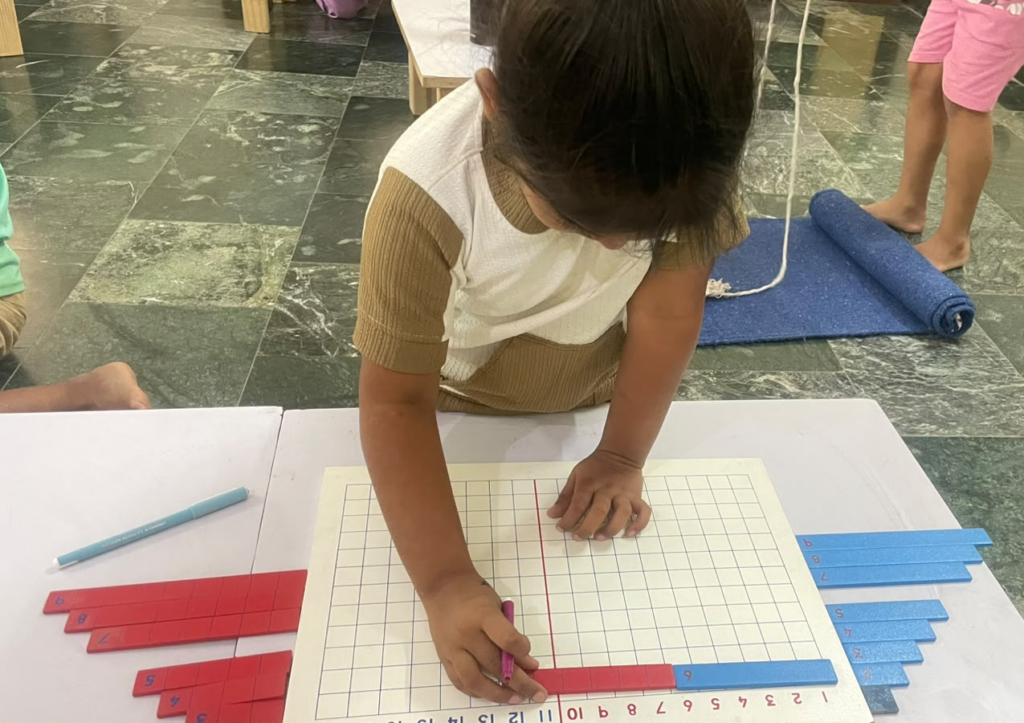
Rural parents can wonder whether so much exploration leaves enough time for maths and English. Urban parents can wonder whether the projects go deep enough and move fast enough. We do not run two programmes. Within one programme, we differentiate wherever we can and give children room to guide their own pace and learning. A child who needs more time with maths gets it, and a child ready to go deeper can. That is what we tell every family.
Explaining the programme to each family is the easier part. Bringing them into one room is still unresolved. We have tried anchoring parent meetings in children’s learning, with mixed results. We think these gatherings need to be more playful and more humane, and they may need to begin in smaller groups. We do not yet know what it takes for all the adults in our community to see each other’s humanity.
The children are already doing it. In the garden and the classroom, they treat what the other brings as something worth having. They are showing us that difference can stay while hierarchy loosens. Our task now is to make the same room for their parents.