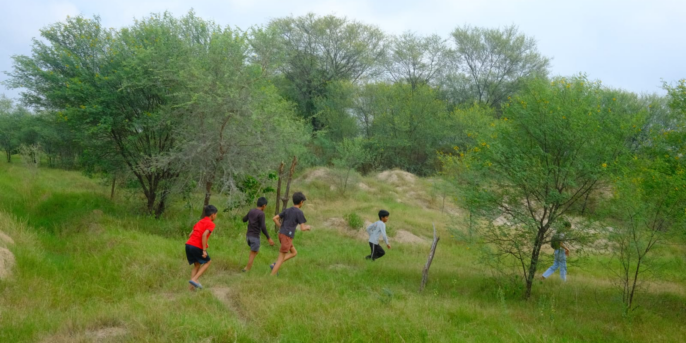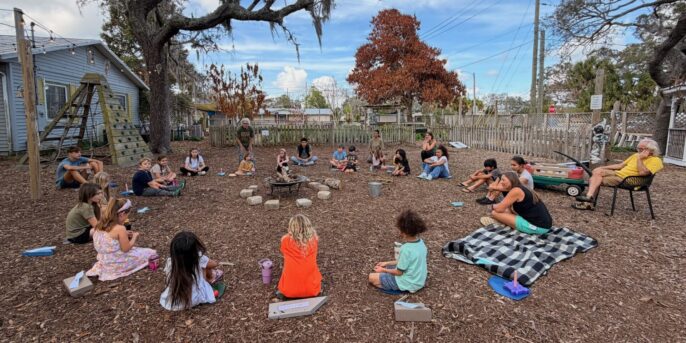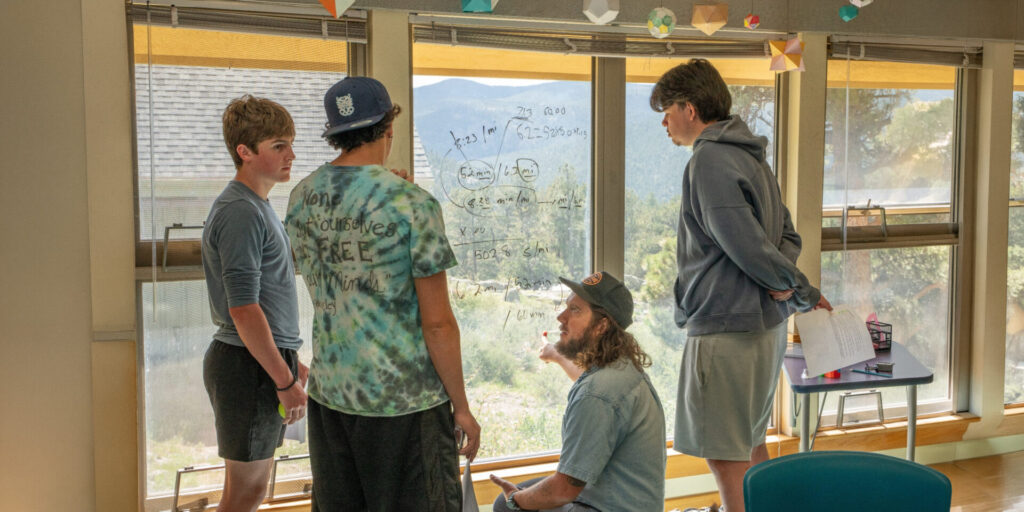
Having just returned from SparkHouse with a remarkable group of Eagle Rock learners, I feel renewed conviction about the future of education. SparkHouse exists to unite and activate young learners from learner-centered environments across the country, fostering a shared commitment to education that truly works for every learner in every community. Over those two days, our learners engaged deeply, explored what learner-centered education actually means, built community through shared experiences, contributed their unique gifts and passions, and emerged with renewed confidence in the power of their voices to effect systemic change.
Watching our students step into their power as advocates and leaders at SparkHouse made it unmistakably clear that learning is naturally resilient when it is built on agency, community, and real human relationships. While the national conversation in education is consumed by panic over artificial intelligence, SparkHouse reminded us that authentic, learner-centered ecosystems were never vulnerable to AI in the first place.
A chatbot can write a student’s essay in seconds. So what were we grading all along?
That question sits at the center of MIT’s report on AI in teaching and learning, released in August by the Ad Hoc Committee on AI Use in Teaching, Learning, and Research Training. The committee doesn’t spend much energy on catching cheaters. Instead, it asks schools to rebuild around assessment that reveals real understanding, human community, and purposeful improvement.
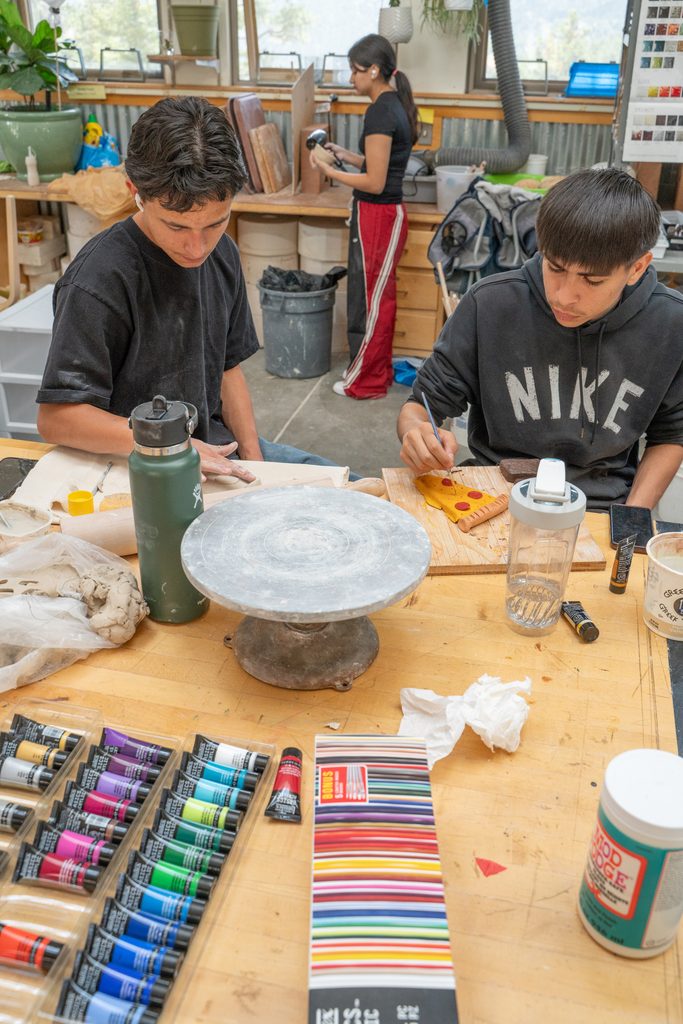
If you are part of the Education Reimagined community, you’ve heard this before. Education Reimagined describes learner-centered education through five core elements: learner agency, socially embedded learning, personalized and relevant learning, open-walled learning, and competency-based learning. We’ve practiced versions of all five at Eagle Rock for over thirty years. Our core takeaway is that AI-proof practice and learner-centered practice are the same practice.
Nobody in the early 1990s was thinking about generative AI. But when Eagle Rock opened in 1993, we built a school around what AI can never touch: students defending their thinking out loud, portfolios that demonstrate growth over time, projects created for authentic audiences, and a residential community grounded in relational trust. We weren’t designed to fight a technology that didn’t exist. We were built for authentic learning in community—and AI can’t fake that.
Eagle Rock operates as both a tuition-free residential school and a Professional Development Center (PDC), and the two feed each other continuously through youth-adult partnership. Students and faculty learn and lead side by side on campus, shaping our national work with educators. In turn, what we learn alongside partners across the country comes home to improve our school. Our mission is to prepare the next generation of leaders, both learners and educators, to break down unjust systems.
Here is how ten of MIT’s primary recommendations align directly with Eagle Rock’s learner-centered ecosystem.
Show Us What You Know
MIT’s committee suggests oral exams (§3.1.2). A chatbot cannot answer real-time, probing follow-up questions on a student’s behalf. In a Presentation of Learning (POL), Eagle Rock students make the case for their personal growth and academic learning out loud, in public, and in front of a live audience that provides helpful, kind, and specific feedback. Students compose personalized rubrics to guide the panel on where they want targeted feedback. They deliver a debut POL at the end of their first trimester and culminate with an hour-long presentation at graduation, the high school equivalent of a master’s thesis defense.
POLs aren’t where credit is earned; documented mastery in learning experiences does that. A POL is an opportunity to pause, reflect, and synthesize learning, aligning directly with MIT’s finding that live feedback often teaches far more than a grade (§2.4). It is learner agency and competency-based learning in action.
MIT also recommends semester portfolios (§3.1.2, §3.1.6). Ours live inside our Learning Experiences, where our Instructional Specialists (teachers) use them next to exhibitions, performances, projects like Sk8 or Die, and presentations. Open one, and you’ll find the drafts and the thinking beside the finished piece. When a polished product is easy to fake, the messy middle is the evidence.
No Grades, No Grade Levels
MIT questions whether letter grades best signal mastery (§3.1.6) and suggests exploring alternative systems of grading and assessment. We can speak directly to this. Eagle Rock has been competency-based since 1993 and has never used traditional grades. Students earn credit by demonstrating proficiency, using competency-based learning to drive equitable attainment of high standards.
This is the backward design model MIT advocates (§2.5) applied across an entire institution: define what students should know, be able to do, and value, then gather authentic evidence. When true mastery is the goal, there is little left to game. We design all our courses this way.
Work That Somebody’s Waiting For
Experiential education transforms lives, and MIT calls for more of it (§3.1.3). In courses like Meow Wolf: The Art of Immersion, students transformed a campus building into an interactive art installation. In (Eagle) Rock the Vote, students run campus-wide campaigns, attend election rallies, and engage in dialogue across the political spectrum. Fiber Arts students share wearable creations at a live public fashion show.
Through our Real World Learning term, students partner with advisors to design personalized learning experiences around their interests, academic needs, and future goals. This is personalized, relevant, open-walled learning built into the school’s core structure.
Students on the Stage
MIT recommends a structured, in-person social component in every subject (§3.1.4, §3.1.5). Ours is a class called Youth-Adult Partnership in Action: Leading Educational Change. Students deliver a 75-minute keynote at a national conference, use Hart’s Ladder to analyze who holds power within our school, and share rapid-fire, two-minute stories with school leaders. It builds presentation, collaboration, and critical-thinking skills and pushes students to challenge personal and systemic boundaries.
It doesn’t stay in the classroom, either. This fall, students delivered their keynote at the Center for Leadership & Educational Equity’s Fall Meeting, presented at the Colorado Innovates conference, and participated in Education Reimagined’s SparkHouse. They’ve also recently co-presented at the Big Bang conference hosted by Big Picture Learning. That’s socially embedded, open-walled learning, and it’s what MIT means when it talks about sharing your work and seeing yourself as part of the field. We empower and support students to become catalysts of change in their lives and communities. This is what that looks like.
Living It
MIT expresses concern that AI will reduce education to a transactional process focused strictly on output rather than community (§3.2, §2.8). Yet much of what shapes a human being never appears on a syllabus. Every new Eagle Rock student begins with a 21-day backcountry backpacking course to build trust and embody shared values. On campus, everyone shares daily responsibilities—cooking, cleaning, and grounds maintenance. Service initiatives like EagleServe connect students directly to the local community three times a year.
We bring this same relational foundation to our national Changemaker Cohort. Launch week features drum circles and Origin Story sessions so adults connect as human beings before exploring school redesign. While MIT calls for new institutional rituals, we have held all-school community gatherings four days a week for over thirty years.
Whose Rules Are They?
MIT emphasizes that students must believe doing the work themselves serves their own growth, noting that top-down mandates fail to inspire intrinsic motivation (§2.4, §3.2.1). Agency is the missing ingredient. In our Human Sexuality course, students write the course goal statement together. In our Changemaker projects, Collective Leadership Committees of students and staff use Improvement Science to co-design school structures.
When harm occurs, we treat it as a disruption to relationships rather than a rule violation, focusing on restorative repair rather than punishment. Our foundational 8+5=10 philosophy, co-created with our inaugural student cohort in 1993, provides a values-based framework that no rigid rulebook could match. When students help shape the culture, they take ownership of the learning.
Ask First
MIT’s report emerged from extensive listening sessions (§2.8). At Eagle Rock, meaningful design begins with Empathy Interviews. When a student-staff team joined our Changemaker Cohort to re-examine graduation requirements, they began by interviewing current students, alums, and staff. They learned that traditional transcripts failed to capture personal well-being and holistic growth. Those insights reframed the challenge before anyone proposed a solution.
Taking time to understand a problem of practice thoroughly prevents premature solutions. Empathy Interviews keep us grounded in asking who a practice or tool is for and why it exists, ensuring the learning community—not outside “experts” or software—drives the answer.
Getting Better in Public
MIT’s first principle is humility. It asks for ongoing reflection, iteration, and improvement, and for communities of practice instead of generic training (§2.1, §3.3). That’s how the PDC works. We use CLEE protocols to tackle the sticky dilemmas that come up on campus, and we treat them as shared problems to study and solve. Our instructors have written about lesson study and student-centered coaching. Beyond campus, we use Improvement Science and PDSA cycles, shared our work in Youth Adult Partnership at the National Summit on Improvement in Education at High Tech High, and we’ve convened Network Improvement Communities.
Learning to Teach by Teaching
MIT warns that automated tools risk replacing entry-level research and teaching roles, stripping away the mentorship through which individuals enter a profession (§3.1.5). In partnership with the Colorado Department of Education, our PDC operates an in-house teacher licensure program. Emerging educators teach together with experienced Instructional Specialists and receive continuous coaching and mentorship. You learn to lead by doing authentic work alongside experienced practitioners.
What Sits Underneath
Behind each of these practices are fundamental commitments we return to whenever we design something new:
- Competency over seat time
- Restorative approach instead of punitive discipline
- Holistic development over narrow academics
- Deep, engaging experiences over broad survey courses
- Equity and inclusion over systemic exclusion
- Beloved community over individualism
- Shared values over top-down rules
- Embodied leadership over compliance
- Asset-based thinking over deficit mindsets
Practical Steps for Any Learning Environment
Redesigning learning does not require a new facility or a sizable budget. You can start small:
- Redesign one assessment: Swap a high-stakes written assignment for a live oral defense or presentation of learning.
- Expose the process: Require drafts, iterations, and reflective journals alongside final submissions.
- Find an authentic audience: Connect student work to real community needs so there is purpose beyond a letter grade.
- Co-create norms: Draft classroom commitments together with students; young people honor what they help build.
As the authors of the MIT report acknowledge, no single institution has everything completely figured out. But the central lesson is that education should produce a human learner, not a transcript or a diploma. Learning environments built around agency, strong relationships, authentic work, and demonstrated mastery do not need to panic in the age of AI. The AI era is simply stress-testing what learner-centered ecosystems were built to do all along: prepare young people to lead, adapt, and build a more just world.
Eagle Rock School, a Corporate Social Responsibility initiative of American Honda Motor Co., is a tuition-free, residential high school in Estes Park, Colorado. The Eagle Rock Professional Development Center works with Changemakers (educators and students) committed to preparing the next generation of leaders. We empower and support educators and students to become catalysts of change in their lives and communities, and we’re interested in working with Changemakers who are boldly committed to charting a new path, together.