Learning for an Uncertain World—Q&A with Susan Haws and Kevin Georgas of Insight Colearning Center
BY Susan Haws and Kevin Georgas
July 13, 2026
If you were to visit Insight Colearning Center in Durham, North Carolina, you might encounter learners in their own worlds. Not daydreaming, but as a part of a world-building elective where Dungeons & Dragons meets Model UN. Learners create cultures, languages, economies, and relationships between nations, then begin interacting with one another’s worlds to trade and navigate diplomacy. They’re building fictional worlds to understand the real one.
This type of imaginative and rigorous learning that is rooted in the complexity of real life is reflective of Insight’s mission to prepare teenagers to make a difference in an uncertain and changing world. We recently spoke with Susan Haws and Kevin Georgas, Insight Colearning Center’s leadership team, about building a learning community where teenagers can discover their passions, connect with their city, and develop the skills to make a difference.
Q: What sparked the launch of Insight Colearning?
Susan: Insight was born out of an urgent need felt in our community. The need arose out of a number of teens needing to leave the schools they were enrolled in because those schools weren’t serving them in the full ways they needed. We started out as a very temporary structure—we rented space in a yoga studio with card tables that we bought at Target, and offered humanities, science, and math classes for teens four days a week. When that seemed to work well, we moved into a community center and decided to start a nonprofit organization to formalize Insight. We worked with students to build out the full model, including assessments and additional components we could offer alongside the interdisciplinary courses. About a year later, we learned that a lot of teens wanted to graduate from a school—they didn’t want to graduate from homeschool. We pursued a transition to a North Carolina independent school, moved into a space in Durham’s “Reuse Arts District,” and we’ve been on that road ever since.
Q: The mission of Insight Colearning is to prepare teenagers to make a difference in a rapidly changing and uncertain world. How does the structure of your program support that mission?
Susan: We prioritize learning within and across disciplines in a deep, meaningful way so that learners can begin to understand the complexity of the world—how societies and communities have developed over time, where the problems we’re facing come from, and the nuance needed to address these issues now and into the future. Our entire design rests on forming this dynamic and diverse learning community, which is fundamentally required to address the problems we face as a society. We have an outdoor learning component, an experiential learning component, and coursework. We see these things working together to help students develop and practice the skills they need right now to ground them in a way of seeing the world in complex terms and not be paralyzed by it.
Kevin: Even the acknowledgment that the world is uncertain and rapidly changing is important. Traditional education assumes durable institutions and stable ways of life. By saying that Insight exists to help teens make a difference in a rapidly changing and uncertain world, part of what we’re saying is that we live in a time where those structures are not so durable—they’re pretty fluid. Institutions are not stable in the same way that they were 20, 30, 40, or 50 years ago, and that means teens need different skillsets. Part of that is inviting teens to imagine what’s possible, and that means trying things out, experimenting, and meeting with people around town who are building different ways of life and organizing for different futures.
There’s not a ready-made curriculum out there in the world, so we’re designing a curriculum that invites them to imagine what’s possible.
Kevin georgas
With experiential learning, students are actually doing things—they’re learning how to navigate in the wilderness, they’re consulting for local businesses and coming up with actual solutions, they’re going through a democratic organizing process that grassroots organizations go through. They are doing all of these things and then, at the same time, we’re going into our seminars and saying: “How can we read our world and imagine what’s possible from a theoretical perspective by looking towards all the stories of creativity and the ways that people have innovated and experimented in the past?” There’s not a ready-made curriculum out there for life, so we’re designing a curriculum that invites them to imagine what’s possible.
That’s part of our assessment model, too. In an uncertain world, the kind of learning that we need isn’t the sort of thing that you can just tick off a checkbox. When high-achieving students get into college, a workplace, or a creative community where they’re among other high achievers, they often don’t know what to do. If they’ve always been at the top level everywhere they’ve been, they don’t necessarily know how to respond in a setting where everyone around them is also used to being “the best.”
Our 14 Learning Objectives and proficiency scale are designed so students understand that there’s no such thing as maxing out, or hitting the ceiling at Insight. There are progressive levels of proficiency in 14 core learning objectives. At the lowest level of the scale, you’re not doing anything at all; at the highest level, you are consistently demonstrating a skill at a level on par with professionals. The proficiency levels in between allow for specific coaching on how to get better. That makes education more like other areas in students’ lives.
For example, if I’m coaching baseball and I say “that’s an A- swing,” that’s not very useful information for a student. But if I say, “your front shoulder’s flying open, and that pulls your eyes off the ball,” you can fix one little thing and all of a sudden, you get a different result. At that point, you’re not talking about abstract standards, you’re talking about the details of craft. With our assessment model, we’re trying to apply that mindset to academic learning, too, so that students know there’s no end to their pursuit of proficiency.
Q: How do you help learners connect to the local community?
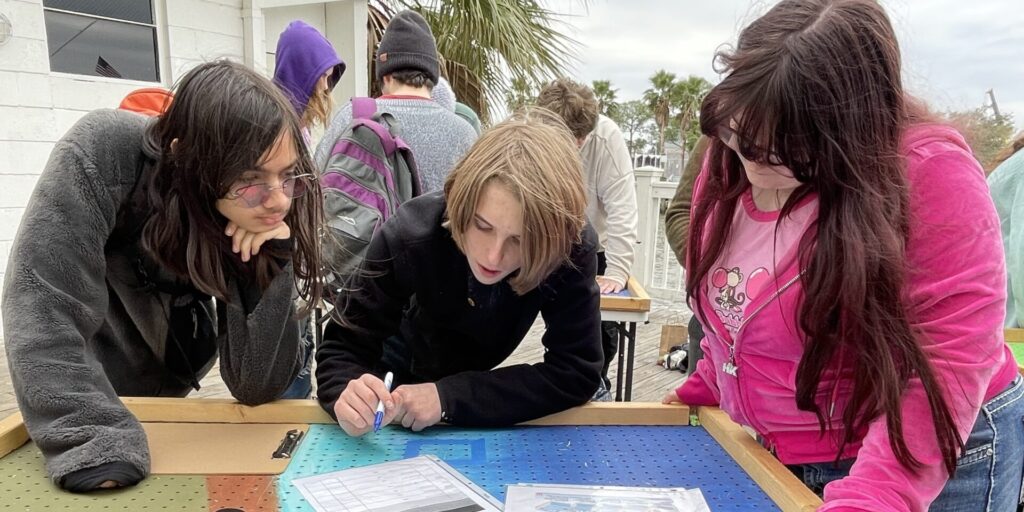
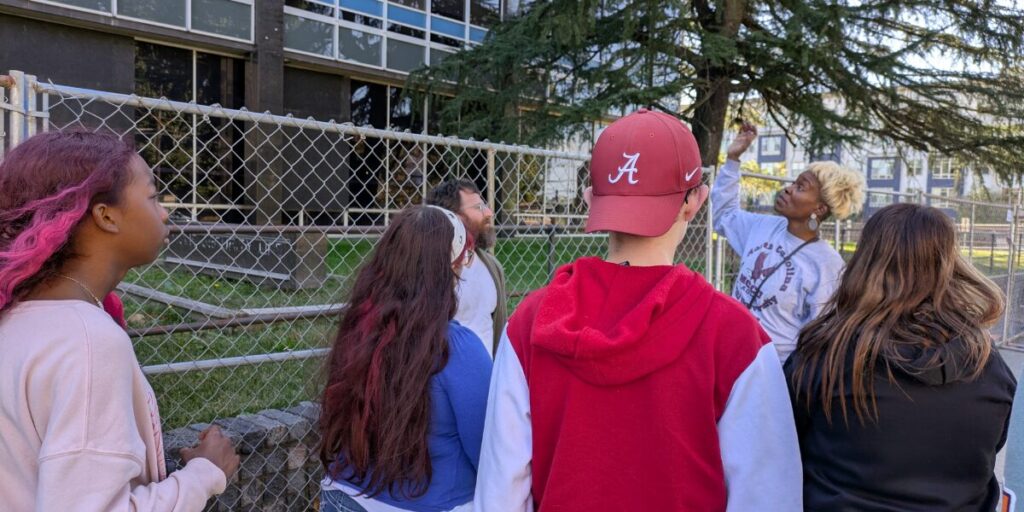
Susan: We connect to the outside community via service learning, internships, and our newly revised experiential learning, which includes a series of noticing exercises where we discover Durham. We get to know our community by going out into it and seeing what the political structures are, what the social structures are, who has access to which community resources, who speaks for the community, and who lives here. We do a number of outings and bring in people from the outside to get different perspectives and better understand where we are in time and space. We also use the Generation Citizen curriculum, where students learn about participatory democracy by doing it.
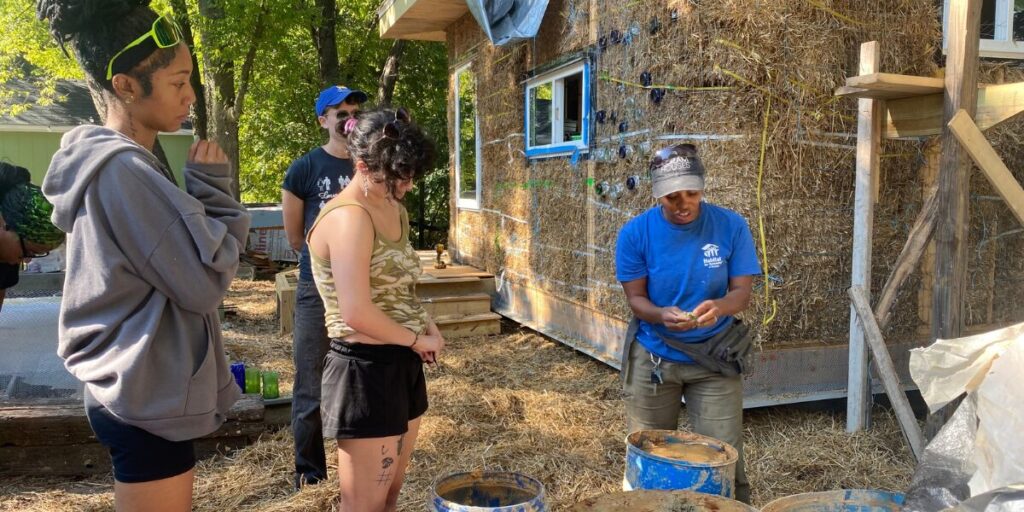
In the next phase of experiential learning, students learn how to build and sustain a community—how to garden, how to cook, how to care for animals, how to build small structures, how to help your neighbors, and how to distribute extra food that you have. These are all the result of community partnerships. For internships, we leverage our networks to find people that do things our students are interested in and who are also suited to mentor students in those roles. A lot of schools go out to industry and ask, “Who wants interns?” and then bring the opportunities back to students as choices. We do it the opposite way. We figure out what our students want to do, and we go find internships that match their needs and interests, which is a lot harder but more impactful when your goal is to help students discover how they can use their skills and interests to make a difference.
Q: Insight Colearning was designed with twice exceptional learners in mind. How has this helped you better serve all learners?
Kevin: I think the best practices for twice exceptional learners are also the best practices for everybody. There’s an invitation to be really careful and intentional in design because they will notice ambiguities; they will notice when there’s an instruction that’s not as clear as it could be. Some of our students, especially our students on the autism spectrum, will latch very literally onto what the instruction is, and if the literal instruction is not exactly what you intend, some wires are going to get crossed. Working with these learners sharpens us as educators. It puts us in a human-centered design mindset, where we’ve got to embody their viewpoint and imagine things from their perspective.
Working with twice exceptional learners over the years has helped us prioritize what’s important in a learning experience.
Susan haws
Our twice exceptional learners also need a lot of novelty and spontaneity. You can’t just create a routine or put yourself on autopilot. You need a strong plan and the ability to improvise on the fly when it’s not working. Having twice exceptional learners in mind better serves everybody because the plans have to be fine-tuned. There has to be a strong intention behind them, and, at the same time, we have to be attentive to what everybody’s needs are at the moment. Designing in this way creates both the structure and spontaneity that everybody actually needs.
Susan: Working with twice exceptional learners over the years has helped us prioritize what’s important in a learning experience. Often, students with this profile don’t do well with just more and more work. It creates overload. I think we have done a good job of asking ourselves what is required, what is an appropriate amount to expect, and where people benefit from breaks and flexibility.
Q: How do you help learners identify what their passions are, what electives they might be interested in, and what they might want to do to support themselves and their community in the future?
Susan: We assign students to advisors based on a broad category of matching interests or views of the world—students who love literature go to Kevin, those drawn to the outdoors or engineering go to Carson. The advisor’s task is to get to know the student and to be their academic, intellectual mentor through the program. They have one-on-one conversations every other week, and the advisor is also checking in with other teachers on how each of their advisees is doing. Students stay with the same advisor over the time that they’re at Insight, and they have ongoing conversations about how their interests are evolving, especially how those interests are piqued by classes and experiences.
Then we have some structured activities that we categorize as “wayfinding activities,” and those are typically guided exercises that play out over time to help students more directly articulate what they view as their evolving interests. At the culmination of the experience, they do a “transforming project” (aka “senior project”), where they have full agency to select their topic and design their scope of work.
As I mentioned, students have input and choice on their internship placements. Then they reflect back on their experience to say “yes, this is my interest,” or “actually, this is not my interest.” So, they’re sampling over time to get closer and closer to what really interests them.
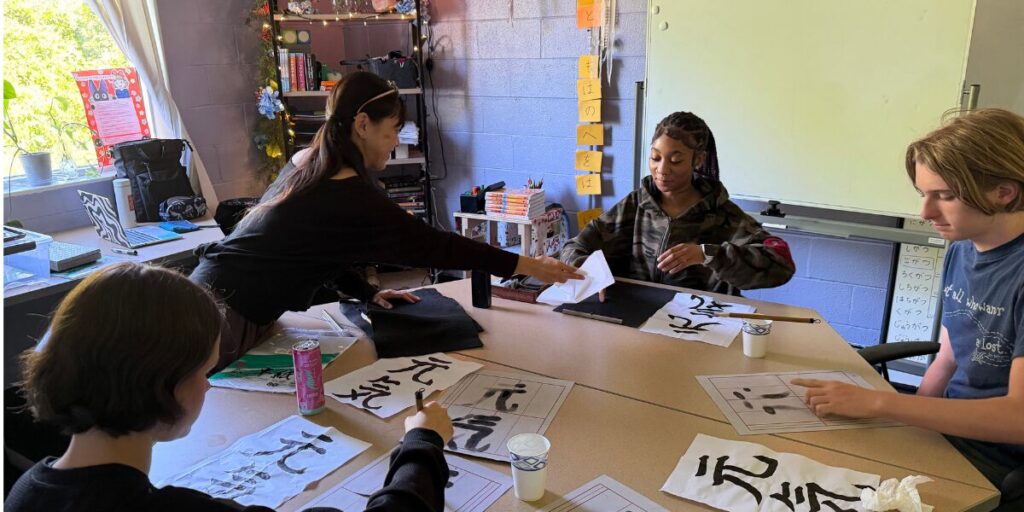
In addition to internships, we pull from student interests to develop our elective offerings. For example, a couple of years ago, Kevin polled everyone in a community meeting about electives, and boxing emerged as a very strong interest. So we searched all over for a boxing coach to teach a boxing elective. We always have a visual arts elective. We’ve had a number of people interested in DIY building activities, leading to a shop class. And this year, we had an elective on world-building that was probably the most popular elective we’ve ever had. By intentionally listening to our students, we’re able to help them discover what they think their passions are and then further explore those.
Kevin: Having passionate teachers is an important part of that as well. A lot of us don’t know that we’re interested in something until someone shows it to us or until someone says, “Actually, this is really cool!” We’ve had students say that they didn’t like science before, but the way our instructor talks about the integration of systems and the contexts of research made them realize how they do care about figuring out how things work and what causes things to come into being. I’ve had students in my class say they did the Odyssey at another school and thought they hated it, but then they realized that this kind of storytelling is all about how we relate to our neighbors and what it means to belong to a community. Having instructors who care about being educators, but who also are really passionate about their field, is an important part of building a program.
Susan Haws
Founder and Executive Director, Insight Colearning Center
Susan is the Founder and Executive Director of Insight Colearning. She holds a B.A. from Davidson College, and an MPH and PhD in Health Behavior from UNC Gillings School of Global Public Health. Prior to founding Insight in 2018, she was a secondary educator, prevention researcher, program evaluator, and adjunct professor. Susan started her career as a 1993 Teach for America Corps Member in Donna, TX.
Kevin Georgas
Director of Curriculum and Instruction, Insight Colearning Center
Kevin is the Director of Curriculum and Instruction and the lead Humanities instructor at Insight Colearning. Kevin holds a B.A, in Great Texts from Baylor University and an MDiv from Duke Divinity School, which he has used to foster communities of care and social action. Prior to joining Insight in 2022, he was a secondary educator, pastor, and arts administrator. His interests are eclectic, but mostly lie at the intersection of art, politics, and religion.